Much has been written about this amazing builder, Civil War veteran and author. Isaac was a Waddington resident from 1884-1890 during which time he produced two of his most famous works: the Waddington Town Hall and the Chamberlain’s Corner Bridge. Also during his time here, three of his nine children were born.
The following statement was part of a Waddington news article in the July 23, 1884 edition of the Gouverneur Free Press:
“The citizens of our patriotic town are erecting a fine town hall which is to cost from $10,000. It is to be built of stone and will be an imposing edifice. Mr. Isaac Johnson, a colored gentleman from West Winchester, Ont. is the contractor and one of the best architects in the country.”
Nolan Cool, the Educational Program Director for Adirondack Architectural Heritage (AARCH) has studied Johnson’s life extensively and wrote the following in his Feb. 2019 AARCH article entitled: “Isaac Johnson: Stone Mason & Freedom Seeker”.
Isaac Johnson was born in Elizabethtown, Nelson County, Kentucky around 1844 to Richard Yeager and an enslaved African partner named Jane Johnson. Isaac lived alongside three brothers on a Kentucky farm, presumably belonging to farmer George Peak, Richard Yeager’s stepfather. In his 1901 memoir Slavery Days in Old Kentucky, Isaac explained that his childhood house was “divided into two rooms, a kitchen and bed room” with a fireplace at one end, and a “foundation being large flat stones on which the cooking was done.” According to Johnson, ridicule from his neighbors forced Yeager to sell his wife Jane, and their four children to neighboring enslavers in 1851. Jane was auctioned off and sold for $1,100, and seven-year-old Isaac was purchased for $700. Altogether, $3,300 was exchanged for his family in Johnson’s telling.
Forced into enslavement, Isaac Johnson’s labor and personhood was purchased by William Mattingly, and later, Mattingly’s brother John, a white Kentucky tobacco farmer. Mattingly forced Johnson to work 16 hour days alongside numerous other enslaved black persons. In his memoir, Johnson poignantly remarked that slavery “not only degraded the slave, but it degraded the master even more.” During the Civil War, Union Army troops swept through Kentucky and Isaac Johnson successfully escaped to Union Army lines after two prior attempts. He travelled to Detroit and joined the First Michigan Colored Infantry of the 102nd United States Colored Regiment, and later battled Confederate forces at Honey Hill, South Carolina, where he sustained three gunshot wounds and lost a finger.
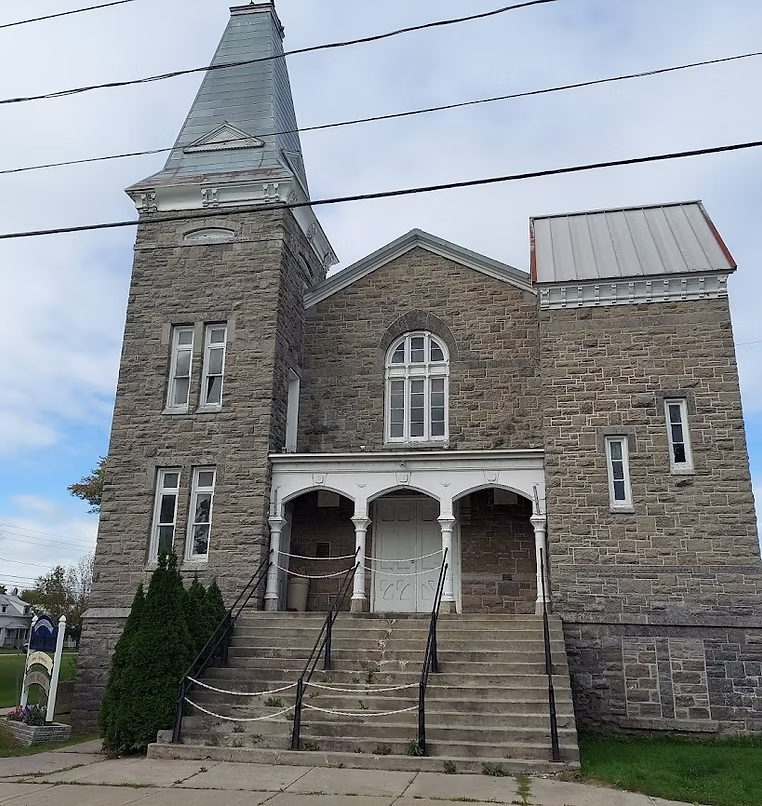
After the war, Johnson made his way to Ontario, Canada, where he took up work as a “lime mason” sometime during the early 1870s. Living along the New York-Ontario border, he met and married Theodocia Allen, a maid from Franklin County. For years, Johnson worked as a stonecutter across a number of limestone quarries between New York and Ontario. Later, he began work as a builder of stone structures, using a skillset that he may have obtained from his time enslaved in Kentucky. Between 1884 and 1889 Johnson completed four major projects in the North Country, mostly notably the Waddington Town Hall in 1884 (shown below). As lead mason on the project for “one of the best town halls in the country,” newspapers conveyed that “Mr. Isaac Johnson, a colored man from West Winchester, Ont. is the contractor and one of the best architects in the country.”
His successful oversight spurred his relocation across the border when he garnered two contracts in the North Country — for the Town Hall in Waddington which is now on the National Register For Historic Places, and for an arched bridge over the Grasse River at Chamberlain’s Corners, both of which are still in use. Concerning the former, the Watertown Daily Times reported recently that while the interior of this building has been refurbished, the exterior “remains mainly untouched ….” as plans call for it to “become the hub for huge events” in the village in the future. While living in Waddington, Johnson’s future in the building arts took shape. A strong chronology of the next chapters in Johnson’s life can be found in Hope Irvin Marston’s children’s book, Isaac Johnson: From Slave To Stone Cutter (1995).
The following segment from Richard White’s article “Isaac Johnson: Former Slave, Master Mason” in the Dec. 10, 2018 edition of the Adirondack Almanack describes the remainder of Johnson’s life…
Not all of his projects were extensive. In 1887, Johnson acquired a job at a private residence in nearby Ogdensburg. On October 6, the Ogdensburg Advance pointed out that “Mrs. Senator Pierce is making extensive improvements on her house and grounds. Isaac Johnson is in charge of the stone work…” While Johnson worked primarily in St. Lawrence County, his talents were called upon in 1888 to erect a Catholic Church in Churubusco in Clinton County. But new opportunities prompted Johnson to relocate to Ogdensburg in 1890 where projects awaited.
In fact, there has been research on Johnson’s work at the new NYS Psychiatric Center in the Burg. While at St. Lawrence University’s Department of History, Dr. Cornel Reinhart, along with former Waddington Town Historian, Pauline Tedford, delved into the records. They concluded, according to the Syracuse Herald American on February 26, 1995, that Johnson “worked extensively on several buildings” at the new Center. Newly elected St. Lawrence County Legislator, James Reagen, wrote a series of articles on Johnson in The Ogdensburg Journal in 1995 as well.
Most people, though, are unaware of Johnson’s work contract in expanding the City Hospital and Orphanage. Ogdensburg’s The Daily Journal reported on May 2, 1894 on Johnson’s complicated construction at the crowded City Hospital and Orphanage in the former Ford Mansion on King Street. There would be new stone work, and ‘the entire interior will be finished with all the modern appliances for ventilating, heating and lighting….” The paper says that “there are now some twenty men, under Master Builder Isaac Johnson, employed in erecting additions for the enlargement of the…Hospital….The base of the building has been extended eighty-five feet on the easterly end, and thirty feet on the north and eighty–five feet on the south. The addition is of stone to correspond with the original structure and will be three stories high.” This hospital became part of the Hepburn Hospital in 1918 (now named the Clayton-Hep-burn Hospital.)
Johnson’s construction career came to an end in 1897 when he was injured upon falling from a derrick while cutting stone in Cornwall, Ontario. During his retirement, he wrote/published his memoir, Slavery Days in Old Kentucky, which sold for 25 cents a copy. This was a final part of his enduring public legacy.
The day after his death on December 4, 1905, Ogdensburg’s The Daily Journal could do no better than to declare that Johnson “was of the more intelligent and thrifty type of the African race. He was a first class mechanic….” While these words are racially charged and demeaning to a “Master Builder,” his funeral at St. Mary’s Cathedral a few days later was much more appropriate. The local G.A.R. post and the Stone Masons Union – both of which he was a member – attended the service along with many town and out-of-town people. Johnson’s burial was in the Soldiers’ Plot of the Ogdensburg cemetery with a proper military service. Johnson was a war veteran, an author, a skilled contractor, and a North Country resident who contributed to the growth and pride of the region.