Henry (Hank) James Monk was born in Waddington New York on March 24,1826 and lived on Monk Island. Land records were recorded between the Ogden’s of Waddington and Mathias Monk of Williamsburg, Ontario with Monk paying $750.80 for the island originally known as Haines Island, that contained 134 acres and was located about a 1⁄2 mile west of the northeast corner of Waddington.
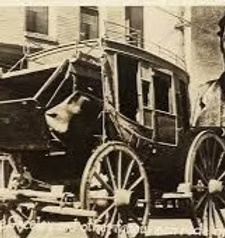
We believe Hank was the youngest child of Mathias and Elizabeth Hanes Monk. The Monks where of German descent from the Schoharie region of New York. They moved to Canada just after the American Revolution. The Hanes family were British loyalists. Hank spent some time in Canada as the Monks also owned property in Williamsburg, Ontario. At the time of Hank’s youth, Waddington was growing and becoming the metropolis of the area thanks to the power of the Saint Lawrence River and the rapids at Waddington. There were many businesses in Waddington when he was growing up, including the Clark House Hotel on Main Street that had a stagecoach run from Ogdensburg to Fort Covington. It is written that at the age of 12, Hank was driving one of the coaches on the runs to Ogdensburg and Fort Covington. While he had to be boosted into the high coach seat, they said he was a competent driver.
In 1849, Hank caught gold fever and hoped to travel West to find his fortune but his mother did not want her son to go. Hank obeyed and remained at home until 1851 when Hank’s father lost the family Island farm and sold the property to Isaac Newton Rose from Canada for the sum of $1800. Hank saw an advertisement for stagecoach drivers in San Francisco, CA and he was ready to go.
According to the Feb. 27, 1913 Madrid Herald article written by W. M. Alexander about Richard Brannen, both Louisville natives, Hank joined up with a group of local young men who also wanted to head West.
HANK MONK AND THE GOLD SEEKERS
From Louisville and Neighboring Towns — Horace Greeley’s Ride
Louisville, Feb. 21 — It is interesting to note that Richard Brennan of Louisville, N.Y., who is past 82 years of age, holds the distinction of being the only surviving member of a party of 28 young men whose homes were in Northern New York and who organized themselves into a party in 1851 to go to the gold diggings of California, the journey in those days being perilous, indeed.
The party sailed from New York in September of that year via the Isthmus of Panama. The following were from Louisville: David Willson, Benjamin Willson, Charles Whalen, Richard Brennan, Alexander Bingham, James Lane, Charles Phillips, Samuel Alexander, Andrew Hadley, Samuel Douglass. From Waddington there were: Thomas Blythe, John Short, Ripley Hatch, Hank Monk, Wagner Monk, James Backus, Matthew Redington, Peter Dalton, Christopher Welch, Charles Montgomery, John Rutherford, Christopher Gorman. From Massena, James Perkins and Allen Maley; From Lisbon, John Tait, Thomas Tait, and Alonzo Lawrence; from Norfolk, Robert Douglass.
The party landed at San Francisco and found the place to be in excitement and embroiled in disorder. One of the party, Hank Monk of Waddington, soon became famous as the pioneer stage-driver of the Rocky Mountains. It was he who had charge of the stage that carried Horace Greeley to lecture there. The stage was far from the village and Mr. Greeley became impatient as the horse moved slowly up the long grade. Leaning out of the stage window, he asked Hank, the driver, if he could not urge the horses on a little faster, the driver replied in the quietest of tones:
“Keep your seat, Horace, I’ll get you there on time.”
The stage crawled slowly on up the steep grade until the hilltop was reached, when, at a signal from the driver, the coach-and-six with its passengers, fairly flew at a terrific pace down the mountain slope covering forty miles in four hours. Mr, Greeley, the Tribune’s noted editor, some time afterward presented Hank with a beautiful gold watch bearing the inscription inside the case, “Presented to Hank Monk in commemoration of his celebrated drive in landing Horace Greeley on time.
W.M. ALEXANDER
Louisville, N.Y.
Hank became famous after Mark Twain wrote about a wild ride given to Mr. Greeley (editor of the NY Tribune) in his 1872 book, “Roughing It”. Hank made a name for himself in the territorial history of Nevada. He was easily recognized as a big man with a round face, a close clipped beard and mustache, a white Stetson and yellow driving gloves. The uniform of his calling! Along with Twain, he was immensely popular and well known to Bart Harte and a host of other notables including Union Civil War General William Sherman and President Rutherford B. Hayes, most of whom he drove over his stage routes.
In addition to Hank’s stage driving talents, his colorful retellings of his adventures endured him to those who crossed his path. In 1878 J.P. Meder composed a song. “Hank Monk Schottische” about the Stagecoach driver. Idah Meacham Strobridge wrote the following in her 1909 book “The Land of Purple Shadows”…
“Hank Monk, the incomparable! The most daring – the most reckless of drivers; and the luckiest. The oddest, the drollest of all the whimsical characters who made Western staging famous the world over… It was a dream come true! I’m quite sure that had anyone asked me which of the two I would rather see – hear – speak to, Hank Monk, or the President (and by that I mean Abraham Lincoln), it would have been the former I unhesitantly would have chosen. Without a doubt my youthful judgment was bias, but the fact remains.”
Brandon Wilding wrote the following in his Nevada Magazine article.
“Hank was known around the country for his great ability to drive a stage and his natural skills with horses and people. On the other hand, in the Carson Valley, Hank was known for another skill. He was a natural storyteller. He had great charm and a way of stretching the truth just far enough to still be believable. Nothing helps stretch a story more than a glass of whiskey, followed by a few dozen more. He wasn’t just a stage-man; he was a drinking man. In Edward B. Scott’s 1957 publication, “The Saga of Lake Tahoe,” he joked, “Monk drank so much hard spirits that he often forgot what he was doing, when it came to incidental tasks connected with staging, and fed whiskey to the horses and watered himself, thus becoming accidentally sober enough to handle the inebriated team.
Hank was loved by the people of the Carson Valley. It is said that he was kind to everyone and never spoke ill about any of his fellow man. The bar stools are a little colder in Nevada and the stories are a little less humorous without Hank Monk around.”
When Hank succumbed to pneumonia on Feb. 28, 1883, Nevada’s Virginia City newspaper, Territorial Enterprise, paid tribute to the folk hero with the following obituary:
HANK MONK, THE FAMOUS STAGECOACH DRIVER IS DEAD
HANK MONK, THE FAMOUS STAGECOACH DRIVER IS DEAD
“He has been on the downgrade for some time. On Wednesday, February 28th his foot lost its hold on the break and his coach could not be stopped until, battered and broken on a sharp turn, it went into the Canyon, black and deep which we call death.”
Hank Monk is buried in the Lone Mountain Cemetery in Carson City, NV.