Taken from “The History of St. Lawrence County, NY 1749-1878 Published by L.H. Everts & Co.
The first white family who made their house in the present town were Dutch and were found living in a hut on the side of the village, by Samuel Allen in March, 1797; every member being clad in deer skin garments. The date of their location, their name, and their fate are all unknown. Mr. Allen is believed to have been the next settler. Certainly he made his home there during the year, for on 14 November, 1797, his son, William L. Allen, was born there, being the first white child born in the present town. A few others were supposed to have made temporary homes there that year, but no land was sold until 1798. So far as known, the first death of a white within the town was that of Daniel Tuttle, who lived on the banks of the St. Lawrence, a short distance above Point Iroquois.
The title of Waddington, except the islands, with the rest of the survey Township of Madrid, which had been laid out and patented by the state several years before, as described in the general history, became invested about the same time in David A. Ogden and Thomas S. Ogden, of New York City. The islands in the St. Lawrence had not been patented by the state because it was not known whether they would belong to this country or Great Britain. They were included, however, in Macomb’s great contract, and were to be conveyed to him or his assigns, if finally allotted to the United States.
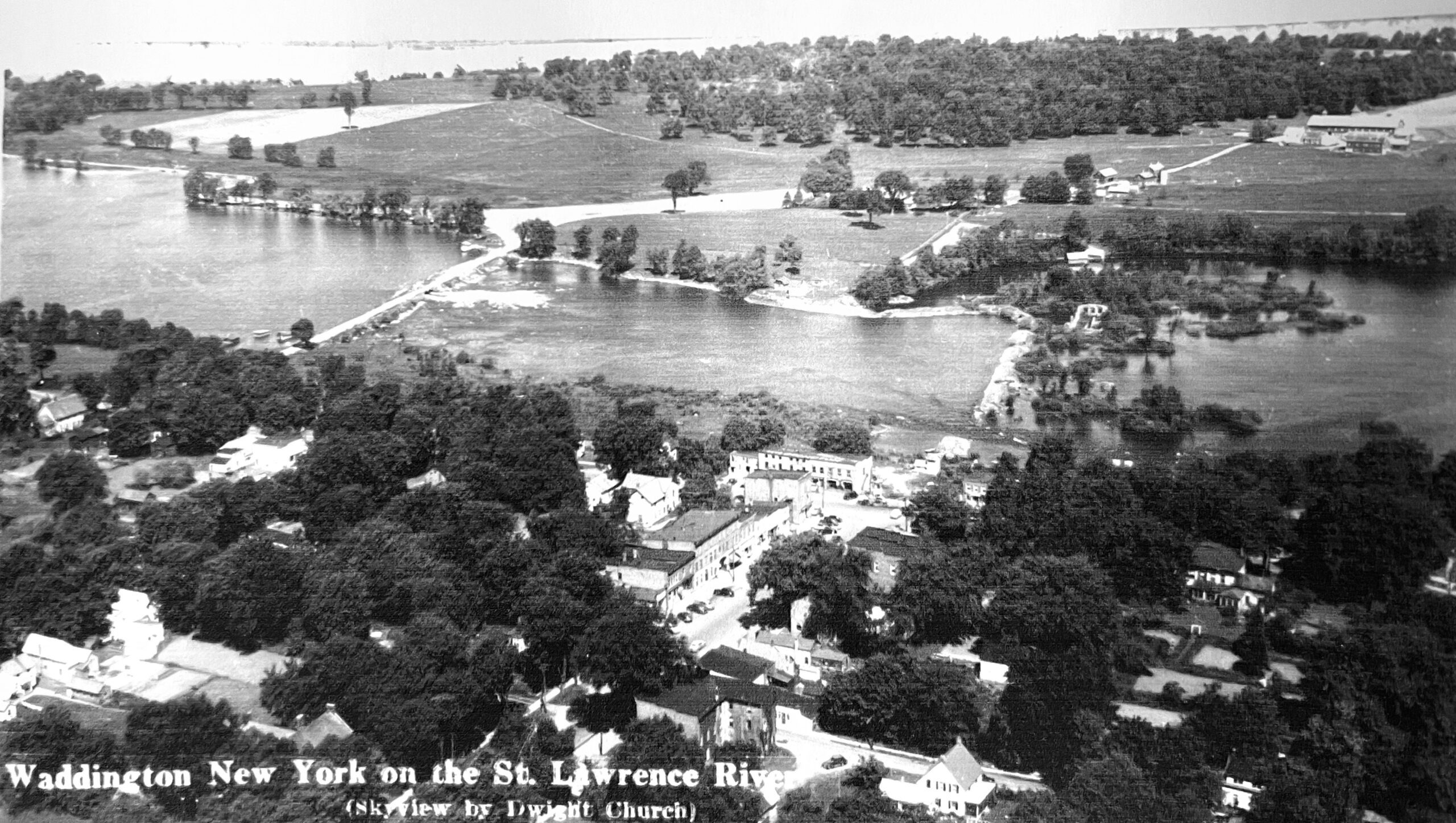
The principal one, lying for 3 miles along the St. Lawrence, and about three-fourths of a mile wide at the broadest point, now called Ogden Island, was then known as “Ile au Rapids Plat.” It was so called from the name, “Rapids Plat,” given by the French to that part of the St. Lawrence northwest of the island, meaning “smooth rapid,” because while the river was here quite swift, it was not so broken as to be dangerous to navigation, and the fall of eleven feet extended over the whole distance of three miles.
On the other hand, the smaller branch of the river, southwest of the island, originally made the whole fall in about 50 rods, opposite the side of Waddington Village. The water rushed swiftly down a rocky incline to the main fall, where it plunged off a distance of nearly eight feet, rebounding as it reached the bottom so as to cause a strong upper flow along the shore. The place was called by the French, “Le Petit Saut,” the little Falls.
In the 1797, Waddington was nominally a part of Herkimer County, which, by law, extended north to a narrow strip from the Mohawk to the St. Lawrence, but, in fact, all this section was then almost out of the jurisdiction of civilized tribunal.
In July 1798, there were at least 12 or 15 residents in the vicinity, for that number were present at a celebration of Independence Day, held at the extreme end of Point Iroquois. Jacob Redington read the Declaration of Independence and made a short speech, and then all the rifles and shotguns in the settlement were fired in honor of the day, and all the men present joined in tumultuous cheering.
The Canadians, astonished at the uproar, and not yet accustomed to Independence days, sent over a “flag of truce” to learn the cause, the bearers of which quietly returned when they learned that no invasion of Canada was mediated. The exercises closed with a ball, the voice of Mrs. Allen being the only music to guide the feet of the dancers.
Joseph Edsall, a native of New Jersey, received the agency of the survey Township of Madrid in June, 1798. The only persons recorded as taking contracts that year were Barton Edsall and John Sharp, though, as has been seen, there were several other residents. Sharp is remembered as having lived on the river, a little above Waddington village.
This land was surveyed or, or partially surveyed, by Benjamin Wright in 1799, and in 1800 it appears to have been fully opened for sale. Lots were laid off all along the river, a sixth of a mile wide on the riverfront, and running back from a mile to a mile and three-quarters. All lots back of this were surveyed a mile square each.
The former were commonly called river-lots, the first retail price being $2.50 per acre; a latter were known as mile-square lots, and we sold at $2 per acre. In June 1800, the following entered into contracts for land, many of them having been already there, and waiting for a chance to purchase; John Tuttle, Benjamin Bartlett Godfrey Myers, Benjamin Cantwell, Elias Demick, Reuben, Fields, Asa Freeman, Samuel Allen, Edward Lawrence, Asa and Jason Fenton, Alexander Brush, James Kilborn, Jacob Carnes, Allen Patterson, Jacob Redington, Robert Sample, Caleb and Cornelius Peck, Henry Allen, William Osborne, Ira Payne, Oliver Linsley, Joseph Orcutt, and Henry and Joseph Erwin. John Montgomery, father of Horace and C.C. Montgomery, also came in this year.
The next year (1801), the only names recorded as purchasers are those of Isaac Bartholomew and Simon Lindley, but it is known that there were others who settled in town that year. The perhaps they did not buy till the next.
Among those were four brothers, Andrew, Walter, Thomas, and Richard Rutherford, all well-to-do Scotchmen from Roxburghshire, who crossed the ocean in 1801, and are known to have taken up their residence in what is now Waddington the same year, as the next January they all signed the petition of the “ten” towns for the creation of St. Lawrence County. The locality they selected was southwest of Waddington village, and has since been sometimes called Rutherford Ridge, but more commonly the “Scotch settlement.”
In the forepart part of this year, a number of settlers, mostly residents of the survey-township of Lisbon, sent a petition to the legislature that the “ten towns” (survey-townships) should be formed into a civil town named Lisbon, and annexed to Clinton County. This was accordingly done and for a year Waddington was a part of Clinton County.
This arrangement, however, suited very few, and, on the third day of March, 1802, in accordance with the almost unanimous petition of the inhabitants, the county of St. Lawrence was erected. By the same act, the survey townships of Potsdam and Madrid were formed into the civil town of Madrid, thus including all that is now Waddington, except the islands in the St. Lawrence, which were afterwards added.
The first town meeting was held on the first day of April, 1802, and although the name was Madrid, yet, as the people nearly all lived in what is now Waddington, we give the name of the officers elected:
Supervisor, Joseph Edsall; Town Clerk, Jacob Redington; Assessors, Cyrus Abernathy, Reuben Field, Alexander Brush, and Henry Erwin; Constable and Collector, Henry Erwin; Overseer of the Poor, Jonathan Tuttle, and Solomon Linsley; Commissioners of Highways, John Sharpe, Isaac Bartholomew, and Ephraim S. Raymond; Fence-viewers, Asa Freeman, Jonathan Allen, and Cyrus Abernathy; Pound-keeper, Edward Lawrence; Overseers of Highways, Jonathan Allen, Alexander Brush, Thomas Rutherford, Oliver Linsley, and Solomon Linsley.
Of these, all but Abernathy, Raymond, S. Linsley and possibly one or two more, were residents of what is now Waddington. Tradition asserts that this first town meeting was held in an open field; the “moderator,” as the presenting officer was then called, being seated on a pine stump. Mr. Edsall, the supervisor, was also appointed one of the first judges of the Court of Common Pleas of the new county, holding that position until 1811.
The principal roads laid out this year were the “great road,” as the commissioners called it. A number of settlers came from New England, especially from Vermont, in this year 1802, and log cabins began to rise in every direction in the forest.
In 1803, D. A. And T. L. Ogden conveyed an undivided third of their land in this vicinity to Joshua Waddington, and these three were for many years joint owners of the territory of Waddington.
In the forepart of the year, a serious difficulty occurred with the St. Regis Indians, who laid claim to the “Ile an Rapide Plat” (Ogden Island), though it had already been sold to the State. The island was covered with valuable pines, and many of these were cut down under the direction of the Indians. Judge Edsall forbade them taking them away.
Much excitement ensued, and some of the Chiefs went so far is to threaten the taking of scalps. This coming to the ears of that energetic pioneer, Nathan Ford, of Ogdensburg, then first judge of the county, he called them to account so sharply that they greatly moderated their tone.
Finally an amicable arrangement was made, by which the Indians agreed to relinquish all claims to the land and standing timber, and Edsall agreed to pay sixty cents for each tree then cut down, if it should be decided that the island belong to the proprietors of Madrid.
In the latter part of the same year, Alexander Richards became agent for the proprietors in place of Judge Edsall. A small grist-mill and saw-mill were built in 1803 and 1804, on the site of Waddington village, the necessary water being obtained by a short raceway without a dam.
Immigration steadily progressed year after year, Vermont and Scotland being still the principal fountainhead. Numerous countrymen of the Rutherfords followed their example, and the “Scotch settlement” grew and prospered, at least as rapidly and well as any other part of the town.
While the Americans had hardly any resources to obtain money, except the making of potash and the of a little timber to Montreal, the Scotch devoted themselves especially to the making of butter, and whether on count of quality or quantity, they certainly, as a class, succeeded better than their Yankee competitors.
Plenty of grain was raised, too, by all classes; but, although this would keep people from hunger, it would bring little or no money; it cost as much as it would sell for to transport it to the seaboard markets.
Meanwhile, whatever business was done in the north part of Madrid, now Waddington, was done on the river-shore opposite the middle of the “Ile au Rapids Plat.”. The place was early named Hamilton by the proprietors, in honor of the distinguished statesman, Alexander Hamilton, who, for several years previous to his death, had been connected in business with D. A. and T. L. Ogden.
There being already a post office of that name in the state, however, the one at the point in question received the name of Madrid being established on 14 December, 1807, with Alexander Richards as the first postmaster. The next year, Mr. Richards was also appointed as associate judge of the common pleas, remaining such as until 1823.
In 1808 a law was passed authorizing the proprietors to build a dam across the south branch of the St. Lawrence at Hamilton with a lock in it fifty feet by ten, which should permit the passage of vessels of two feet draft. The builders were allowed to collect tolls at the rate of fifty-cents per ton for small boats, and twenty-five cents for vessels above two tons.
The whole work was to be completed in three years. A stone dam with a wooden lock was first attempted, but the lock was undermined before it was completed and the work was abandoned. In 1811 the time for its construction was extended, but the war of 1812 necessitated a further postponement.
Meantime settlement was had progressed so rapidly that, according to the census of 1810, there were then fourteen hundred and twenty people in the town of Madrid of whom probably two-thirds were in what is now Waddington.
Madrid had then a larger population than any other town in the county, it being nearly two hundred larger than that of Oswegatchie, and five hundred more than that of Potsdam. There was a port of entry established at Hamilton as early as 1810, Colonel Mathew Myers being the deputy collector in charge.
Colonel Myers was also the first lawyer in Waddington, having been admitted to the practice in the common pleas of St. Lawrence County in 1809, while Gouvernor Ogden was not admitted until 1810. The latter was appointed surrogate in 1813, and held the office eight years.
In 1811 a partial division of Madrid township took place among the three proprietors, D. A. Ogden receiving, with other lands, a tract of eleven hundred and thirty acres, covering the sight of Waddington village, also the mills, dam, and water privilege, and the “Ile au Rapids Plat.”
The title to the latter, however, was still not quite determined between the United States in Canada. About this time Mr. D. A. Ogden withdrew from his law practice in New York City, with a view of making his permanent residence at the beautifully locality of which he was the owner.
The outbreak of the war, however, postponed the consumption of his plans. Mr. Ogden was appointed an associate judge of the common pleas in 1811, retaining the position for years.
Immigration and improvement continued until the beginning of the great international conflict of 1812 when both suddenly stopped. There were then at Hamilton (according to Stadfford’s Gazetteer,” issued the next year) one hundred thirty-five houses, two sawmills, a grist-mill, a fulling mill, a trip-hammer, and several shops. We are inclined to think the number of houses is exaggerated, as it disagrees very much from the estimates of old settlers at this at a still; besides, Stratford gives other statistics which are obvious mistakes.